The British Columbia Social Studies curriculum is particularly amenable to Philosophy for Children pedagogy. While P4C and Art are virtually a perfect match, the discussions are almost solely ideal, rather than practical. To be clear, this has immense value; but practical discussions also have value. Social Studies, perhaps by definition, is a practical exercise. Thankfully, P4C has significant practical applications which can be exploited in conjunction with, for example, the Social Studies curriculum. In this post, I will discuss a few of the curricular “big ideas” which are easily developed using P4C.
Immigration and multiculturalism continue to shape Canadian society and identity.
Social Studies 5 “Big Idea”
This big idea is an invitation to interrogate the notion of multiculturalism in Canada. What does it mean to be Canadian? What is the Canadian “identity”? Is there one? If there is, does it play a positive role in society? How do racism and xenophobia affect racialized Canadians? What is the place of Indigenous peoples in a so-called “multi-cultural” Canada? Does institutional and identity-embedded multiculturalism promote an uncritical and unreflective relativism?
Book suggestion: The Name Jar, by Yangsook Choi
Book suggestion: Shi-shi-etko by Nicola Campbell
Systems of government vary in their respect for human rights and freedoms.
Social Studies 6 “Big Idea”
This big idea is at the heart of political philosophy. What is the goal of the state? Are there such things as innate rights? In what ways are we individuals and in what ways are we members of a society? How does one weigh personal rights versus collective rights or duties?
This is a particularly interesting “big idea” for P4C, because advocating for democracy and democratic ideals was one of, if not the foremost, of P4C founder Matthew Lipman’s goals. Philosophy for Children, on Lipman’s account, was concerned with fostering politically engaged, critical citizens, so that “a more perfect union” may be effected. Second wave P4C has a broader mandate, and it is important to understand the negative effects of, for example, colonization. Moreover, a critical eye can be cast towards so-called “nation building” – the effort of Western nations to force regime change and democracy upon citizens of certain countries.
Also, an interesting distinction can be made between representative democracy and true democracy. Plato believed “true democracy” – i.e. direct democracy – was nothing less than tyranny. So did many of the United States’ founding fathers (see the Federalist Papers). What happens when people are given direct votes on matters affecting minorities? How does indirect/representative democracy change this dynamic? What is our democracy like today? How could it be improved?
Book suggestion: Frog on a Log, by Kes Gray
Media sources can both positively and negatively affect our understanding of important events and issues.
Social Studies 6 “Big Idea”
Trust in the media has, perhaps, never been lower. In the era of “fake news” as well as leaders calling real news “fake news” in an effort to dodge accountability, media literacy is more valuable than ever. The role of media in a democracy is incredibly important. But what happens when media standards are lowered? What happens when media is democratized and anyone with an opinion and a keyboard can make their voice heard? How is this good?; how is it bad? Is censorship always bad? Is free speech always a positive good?
Propaganda (part of the grade six curriculum), for example, was a powerful force in WW2, and continues to be a powerful force today. While stories, as always, can act as P4C provocations for this topic, you can also use images. Here are two I might start a lesson with:

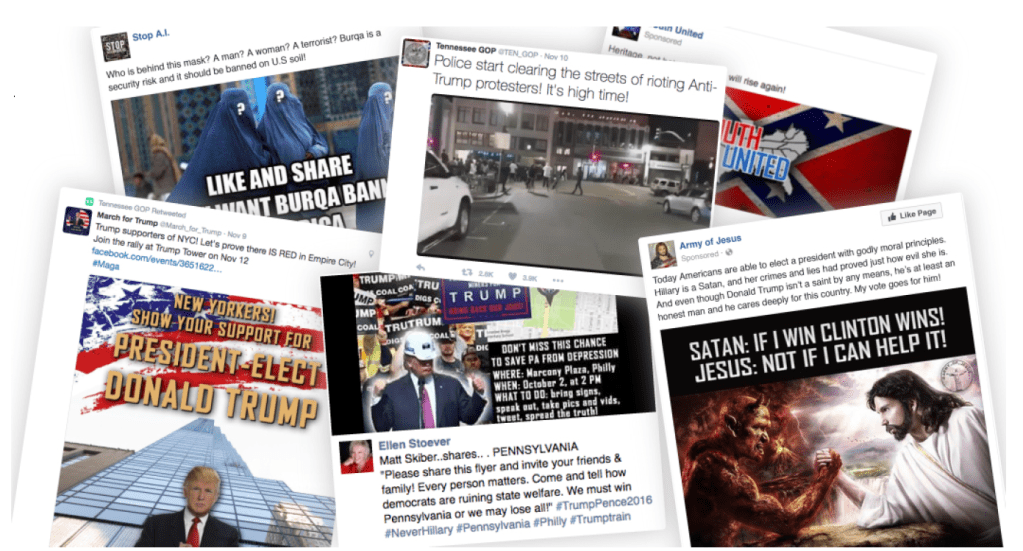
How are the two examples similar?; how are they different? Who authored the them? How do you know? How can you trust what you see on social media? What role do social media companies play in shaping public opinion? What responsibility do they have to the public?
Overall, this is just a tiny scratching of the surface of the possible links between P4C pedagogy and the British Columbia Social Studies curriculum. However, whatever grade that is being taught, P4C offers a powerful tool for students to understand the big ideas and upstream concepts that inform both the curricular competencies and content that are prescribed for each grade.
 Philosophy for Children in the British Columbia Classroom